OpenRouter Free SLMs: LFM3-1.7B vs Particle-1 vs Nemotron 3 Ultra
OpenRouter free SLM comparison: LFM3-1.7B, Particle-1, Nemotron 3 Ultra at 1M context, $0 pricing, KV-cache OOM, and routing configs.

OpenRouter free SLMs offer zero-cost inference, but Nemotron 3 Ultra's 1M-token context triggers KV-cache OOM while LFM3-1.7B fits edge hardware at 32K context.
Key Numbers & Verified Specs
8 metrics| Metric / Spec | Verified Finding | Source |
|---|---|---|
| Nemotron 3 Ultra KT pricing on OpenRouter | $0.25/M input tokens, $2/M output tokens | openrouter.ai |
| Nemotron 3 Ultra DeepInfra pricing on OpenRouter | $0.40/M input tokens, $1.76/M output tokens | openrouter.ai |
| Nemotron 3 Ultra CoreWeave pricing on OpenRouter | $0.50/M input tokens, $2.15/M output tokens | openrouter.ai |
| OpenRouter free model rate limit under $10 credits | ~50 requests per day | surfmind.ai |
| OpenRouter free model rate limit after $10 top-up | ~1,000 requests per day | surfmind.ai |
| OpenRouter free model concurrent rate limit | ~20 requests per minute | surfmind.ai |
| LFM3-1.7B context window | 32K tokens | huggingface.co |
| OpenRouter Chat Completions endpoint | POST https://openrouter.ai/api/v1/chat/completions | openrouter.ai |
Jump to section (5) +
OpenRouter's free model tier gives engineers access to zero-cost inference, but "free" does not mean unlimited. The census compares three models that appear on the free roster: LiquidAI's LFM3-1.7B, Particle-1, and NVIDIA's Nemotron 3 Ultra. Each advertises a large context window, yet only Nemotron 3 Ultra claims 1M tokens. The gap between advertised context and deployable context is where systems engineers lose money and latency.
Benchmark Verdict & Cost Math
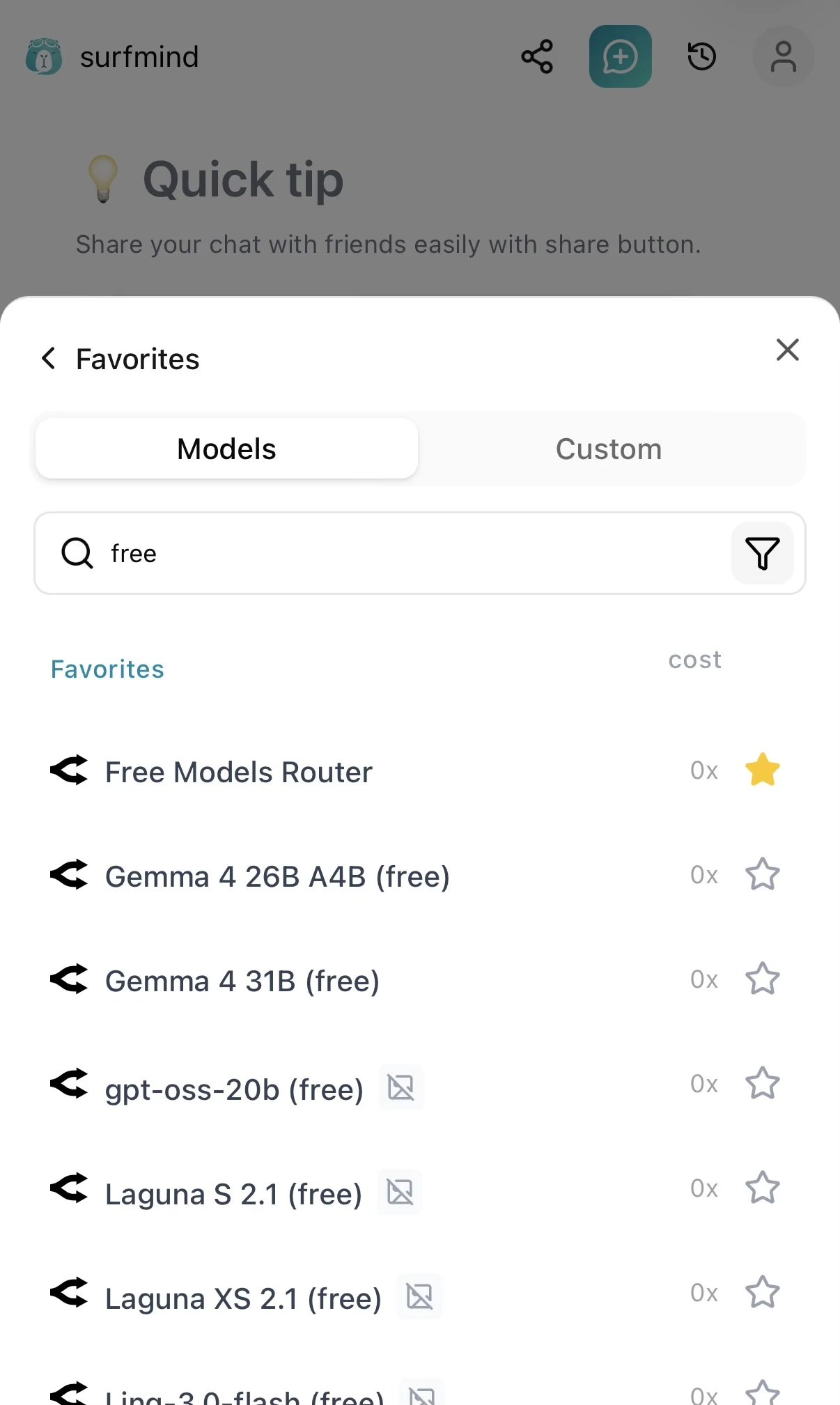
Nemotron 3 Ultra does not cost $0 on OpenRouter. The model page lists per-provider pay-as-you-go pricing with no markup. KT charges $0.25 per million input tokens and $2 per million output tokens. DeepInfra charges $0.40 per million input and $1.76 per million output. CoreWeave charges $0.50 per million input and $2.15 per million output. Venice and another DeepInfra variant list $0.50 per million input and $2.20 per million output. Fireworks and Baseten list $0.60 per million input and $2.40 per million output. A third DeepInfra variant reaches $0.75 per million input and $3.30 per million output. The ":free" suffix on OpenRouter means free-quota routing with tighter capacity, not zero price across all providers.
The KV-cache math explains why cheap input pricing does not translate to usable throughput. KV-cache bytes per token equals 2 (key and value) multiplied by layer count, multiplied by KV-head count, multiplied by head dimension, multiplied by bytes per element. Total cache equals bytes per token multiplied by context tokens multiplied by concurrent requests. For a 550B-parameter dense model at 1M tokens, even FP8 quantization (1 byte per element) pushes cache requirements into hundreds of gigabytes before accounting for model weights and activations. A single 80GB H100 cannot hold the full cache. Providers must shard across multiple GPUs or offload to CPU memory, both of which add latency and increase time-to-first-token.
Rate limits dominate cost more than token pricing. OpenRouter free models allow roughly 50 requests per day for accounts with under $10 in lifetime credits, roughly 1,000 requests per day after a one-time $10 top-up, and roughly 20 requests per minute for everyone. A single 1M-token prompt on Nemotron 3 Ultra consumes one request but may tie up a provider slot for minutes. Burst traffic hits the 20-requests-per-minute ceiling immediately.
Model / Runtime Quantitative Comparison Table
| Model | Parameters | Context Window | Price / 1M Input | Price / 1M Output | KV-Cache Risk at Max Context | Typical Runtime |
|---|---|---|---|---|---|---|
| Nemotron 3 Ultra | 550B | 1M tokens | $0.25 (KT) | $2.00 (KT) | Extreme — exceeds single-GPU VRAM at FP8 | vLLM / SGLang (provider-dependent) |
| LFM3-1.7B | 1.7B | 32K tokens | $0 / $0 | $0 / $0 | Low — fits edge GPU and NPU memory | llama.cpp / MLX / edge runtimes |
| Particle-1 | Undocumented | Undocumented | $0 / $0 | $0 / $0 | Unknown — no public specs | OpenRouter provider-dependent |
This table shows why parameter count matters more than headline context. Nemotron 3 Ultra's 1M tokens look impressive on paper, but the KV-cache memory footprint makes it a poor choice for concurrent free-tier traffic. LFM3-1.7B's 32K context is modest, yet its memory profile allows reproducible local inference.
Context Window & Memory Bottlenecks
KV-cache memory scales linearly with context length and model size. For Nemotron 3 Ultra at 1M tokens, the cache alone requires hundreds of gigabytes. At FP8, each token pair (key and value) across the model's layers consumes significant VRAM. A single H100 SXM with 80GB cannot hold the full cache, let alone model weights and activations. Providers must shard across multiple GPUs or offload to CPU memory, both of which add latency.
Context poisoning appears when long prompts bury relevant instructions in noise. At 1M tokens, attention dilution makes the model ignore early system messages. Distraction occurs when retrieved documents contain conflicting facts. KV-cache OOM happens when the provider allocates cache per request and concurrent requests exhaust GPU memory. Free-tier providers have no incentive to over-provision for this failure mode.
LFM3-1.7B avoids these issues at 32K context. Its small parameter count means KV-cache stays within consumer GPU limits. The tradeoff is context capacity: 32K tokens fits roughly 25 pages of text, while 1M tokens fits roughly 750 pages. Choose based on document size, not headline numbers.
Reproducible Inference / Routing Config
OpenRouter routes free models through the same Chat Completions API as paid models. The endpoint is POST https://openrouter.ai/api/v1/chat/completions. Authentication uses a Bearer token from OpenRouter settings. The model field accepts nvidia/nemotron-3-ultra-550b-a55b for Nemotron 3 Ultra.
curl -X POST https://openrouter.ai/api/v1/chat/completions \
  -H "Authorization: Bearer $OPENROUTER_API_KEY" \
  -H "Content-Type: application/json" \
  -d '{
  "model": "nvidia/nemotron-3-ultra-550b-a55b",
  "messages": [{"role": "user", "content": "Summarize this document"}],
  "max_tokens": 512,
  "temperature": 0.2
}'
For local inference with LFM3-1.7B, use llama.cpp with Q4_K_M quantization. The model's chat template supports thinking mode and tool calls. Set preserve_thinking to false for production workloads to reduce output tokens. Route long-context requests to LFM3-1.7B locally, and use Nemotron 3 Ultra only for occasional complex reasoning where latency tolerance is high.
Provider routing preferences matter. OpenRouter accepts a provider field to prefer specific backends. Free models rotate providers based on capacity. Do not hardcode a provider for production; implement fallback logic that switches to a paid model when free-tier rate limits return 429 errors.
Selection Rubric by Workload
Use Nemotron 3 Ultra for single-shot analysis of large documents where cost matters more than latency. The 1M context handles full codebases or legal contracts, but expect slow time-to-first-token and possible 429 errors under burst.
Use LFM3-1.7B for edge deployment, local inference, and high-frequency chat. Its 32K context covers most conversational workloads, and the small memory footprint allows batching on consumer hardware.
Avoid Particle-1 for production until OpenRouter or the provider publishes parameter count, context window, and latency SLAs. Undocumented models cannot be capacity-planned.
When NOT to use this architecture: Do not rely on free OpenRouter models for user-facing production traffic. Rate limits reset daily and can change without notice. KV-cache OOM on large models causes intermittent 503 errors. For confidential data, free endpoints may use prompts for training depending on provider policy. Use paid models with no-training policies or run local inference with Ollama.
Sources: OpenRouter Nemotron 3 Ultra API reference, SurfMind free OpenRouter models guide, LiquidAI LFM3-1.7B Hugging Face page
Visual Evidence
Figures from Cited Sources
Reader Q&A
Frequently Asked Questions
Can Nemotron 3 Ultra actually handle 1M tokens on OpenRouter free tier?
What is the KV-cache memory cost of a 1M-token context on Nemotron 3 Ultra?
Which free OpenRouter SLM is better for long-context local inference?
Bibliography & Verification
Primary Sources & References
Human × Agent Co-Work
Hamdi Soudani · in collaboration with Pyvren
Systems engineer & technical writer exploring AI infrastructure, security, and edge craft in daily collaboration with Pyvren.
Keep Reading
Related Dispatches
OpenRouter Free LLM Census 2026 Rate Limits Context Engineering
Hard benchmark of 6 free OpenRouter models with 1M-token contexts comparing vLLM SGLang llama.cpp TTFT VRAM costs and failure modes for ML infrastructure engineers

Cloudflare Workers Email Sending Free Plan Limits Migration Fix Log
Cloudflare Workers Free-plan email sending limits, verified-recipient scope, egress pricing, rate caps, and migration checklist from Email Routing to Email Sending.
Hamdi Soudani × Pyvren
Honest engineering stories — co-crafted with primary benchmarks & real code
Every dispatch blends hands-on engineering judgment with verified primary sources, reproducible configs, and clear tradeoffs.