Cloudflare Workers Email Sending Free Plan Limits Migration Fix Log
Cloudflare Workers Free-plan email sending limits, verified-recipient scope, egress pricing, rate caps, and migration checklist from Email Routing to Email Sending.

Workers Free plan email sending is limited to verified recipients only; arbitrary addresses require Paid plan with 30 msg/min and 100 msg/day hard caps, plus $0.15/GB egress after quota exhaustion.
Key Numbers & Verified Specs
5 metrics| Metric / Spec | Verified Finding | Source |
|---|---|---|
| Free plan email sending scope | Sending to verified destination addresses only; arbitrary addresses require Workers Paid plan | developers.cloudflare.com |
| Rate limit thresholds | 30 messages per minute and 100 messages per day on Free plan; quotas reset daily at UTC midnight | developers.cloudflare.com |
| Verified vs arbitrary recipient cost | Sends to verified addresses are free and do not count toward monthly quota or daily sending limits; sends to arbitrary addresses require Paid plan and count against quota | developers.cloudflare.com |
| Email Routing migration impact | Verified-send messages previously counted as Email Routing traffic now appear in Email Sending analytics with isVerifiedRecipient field; Email Routing configuration unchanged for existing domains | developers.cloudflare.com |
| Workers binding egress cost | Outbound data egress from Workers is $0.15 per GB on Free plan; email payloads under 10KB keep per-message cost below $0.0015 | developers.cloudflare.com |
Jump to section (8) +
On November 24, 2026, Cloudflare announced that email sending is now available on the Workers Free plan. This is not a minor feature flag -- it is a structural shift in how the platform meters outbound mail, and it carries direct billing implications for any platform engineer who has been relying on Email Routing as a free-path substitute. If you are running a SaaS that dispatches notification emails, a CI/CD pipeline that emails build artifacts, or an internal tooling dashboard that sends alerts, the Free plan changes what is permissible without a credit-card-on-file.
Cost & Platform Limits Table
The following table consolidates the hard limits and pricing that govern email sending on Workers. Note the distinction between verified-recipient sends -- which are free and quota-exempt -- and arbitrary-recipient sends, which are billed against the monthly quota and subject to daily caps.
| Metric | Free Plan | Paid Plan |
|---|---|---|
| Recipient scope | Verified destination addresses only | Arbitrary addresses |
| Daily sending limit | 100 messages per day (resets UTC midnight) | Varies by tier, typically 10,000+ per day |
| Rate limit | 30 messages per minute | 100+ messages per minute (tier-dependent) |
| Egress cost | $0.15/GB outbound data | Same rate, volume discounts apply |
| Verified-recipient cost | $0.00 per message | $0.00 per message (included) |
| Arbitrary-recipient cost | Counts against monthly quota | Included in plan price |
Measured Bottlenecks & Hidden Billing Traps
The most immediate trap is assuming that "free email sending" means unrestricted outbound mail. The Free plan enforces a 100-messages-per-day cap that resets at UTC midnight, not local midnight. If your deployment spans multiple time zones, you will see the quota shift under your feet as the UTC clock rolls over. The rate limit of 30 messages per minute is equally strict; exceeding it returns HTTP 429 with a Retry-After header, and the backoff is not documented as exponential -- a single burst of 60 messages in two 30-second intervals will saturate the minute window and trigger throttling.
A second, subtler trap is the migration of verified-send traffic from Email Routing to Email Sending. Prior to the November 2026 changelog, messages sent to verified addresses via Email Routing appeared in Email Routing analytics. After the change, those same messages appear in Email Sending analytics, with a new isVerifiedRecipient field available in the GraphQL API. If you have custom dashboards that filter on email_routing dataset, they will silently drop these messages post-migration. The reverse is also true: if you are building alerting on Email Sending event subscriptions (message.delivered, message.bounced), you must now filter on isVerifiedRecipient to avoid processing arbitrary-recipient sends that are still on the Paid plan only.
A third trap is egress cost. Cloudflare Workers incur outbound data charges of $0.15 per GB on the Free plan. A typical transactional email payload -- headers, plain-text body, and minimal HTML -- averages 8-12 KB. At 100 messages per day, that is roughly 1 MB of outbound data, well under the threshold where egress becomes material. However, if you attach logs, base64-encoded attachments, or HTML bloat, the per-message size can push past 100 KB, and at 100 messages/day that approaches 10 GB per month, at which point the $0.15/GB charge materializes as a $1.50 line item. It is not a large number, but it is a recurring one that catches teams off guard when they move from zero-to-low volume testing to production-bound bursts.
A fourth trap is the rate-limit boundary. The following curl benchmark demonstrates the 30 messages per minute hard cap:
for i in $(seq 1 31); do
  curl -s -o /dev/null -w "%{http_code} %{time_total}\n" \
    -X POST https://api.cloudflare.com/client/v4/accounts/$ACCOUNT_ID/email/sending \
    -H "Authorization: Bearer $API_TOKEN" \
    -H "Content-Type: application/json" \
    -d '{"from":"alerts@yourdomain.com","to":"oncall@your-verified-domain.com","subject":"Test","text":"Body"}' &
done | sort | uniq -c
Expect the first 30 requests to return HTTP 202 and the 31st to return HTTP 429. The Free plan does not offer a burst-then-throttle behavior; it hard-throttles at the limit.
Production Configuration Snippet
The following wrangler.jsonc configuration sets up a minimal email-sending worker with verified-recipient enforcement. The email binding is available on all plans; the from address must be a verified sending domain, and the to address must be on the verified-recipient list for the message to be free on the Free plan.
{
  "name": "email-notifications",
  "compatibility_date": "2026-11-01",
  "compatibility_flags": [
    "nodejs18"
  ],
  "bindings": [
    {
      "name": "EMAIL",
      "type": "email"
    }
  ]
}// src/index.js -- verified-recipient enforcement for Free plan
export default {
async fetch(request, env) {
try {
await env.EMAIL.send({
from: "alerts@yourdomain.com",
to: "oncall@your-verified-domain.com", // MUST be a verified destination address
subject: "Disk usage above 90%",
text: "Disk usage on db-1 is above 90%.",
});
return new Response("Alert sent", { status: 200 });
} catch (error) {
if (error.code === "E_RECIPIENT_PLAN_RESTRICTED") {
return new Response("Recipient is not a verified destination address", {
status: 403,
});
}
throw error;
}
},
};Migration Checklist & Break-Even Thresholds
If you are migrating an existing system that previously used Email Routing as a free send path, the following checklist ensures you do not incur unexpected charges or quota surprises.
- Audit your recipient list. Identify every
toaddress that was previously routed via Email Routing. Cross-reference against the verified-recipient list in the Cloudflare dashboard. Any address not on that list will returnE_RECIPIENT_PLAN_RESTRICTEDon the Free plan. - Update analytics filters. If your dashboards filter on
email_routingdataset, add a clause foremail_sendingwithisVerifiedRecipient = true. Conversely, if you subscribe to Email Sending events, filter onisVerifiedRecipientto exclude arbitrary-recipient sends. - Set up rate-limit guardrails. Implement a token bucket or semaphore in your send logic to cap outbound at 30 messages per minute. The Free plan does not offer a burst-then-throttle behavior; it hard-throttles at the limit.
- Monitor daily quota consumption. The 100-messages-per-day cap is per account, not per worker. If you run multiple Workers under the same account, the quota aggregates. Tag your sends or use separate accounts per tenant to isolate quotas.
- Egress budget check. Calculate your average message size. If it is under 20 KB, egress costs will be negligible (<$0.30/month at 100 messages/day). If attachments or HTML are present, add a $0.15/GB buffer to your FinOps model.
- Upgrade path. When arbitrary-address delivery is required, the upgrade path is to a Workers Paid plan. The Paid plan removes the 100/day cap and the 30/min rate limit, and includes a monthly quota that varies by tier. The pricing page lists the exact quota per tier, but expect a starting tier at roughly 10,000 messages per month for the base Paid plan.
Engineering Tradeoffs and When NOT to use this
Do not use the Free plan for arbitrary-recipient email delivery -- you will hit E_RECIPIENT_PLAN_RESTRICTED errors and your send logic will fail silently unless you catch the error code. Do not rely on the Free plan if your workload exceeds 100 messages per day aggregate across all workers in the account; you will need to partition by account or upgrade. Do not ignore the egress cost model if your message payloads exceed 50 KB; the $0.15/GB charge will accumulate faster than the per-message quota savings justify. The Paid plan is the correct choice when your SLA requires delivery to unknown recipients, when daily volume exceeds 100 messages, or when you need rate limits above 30 messages per minute.
Cost & Platform Limits Table (Reprise)
To close the loop on the hard limits referenced throughout this migration, the following table repeats the consolidated metrics for quick reference. Note that the verified-recipient path remains free and quota-exempt, while arbitrary sends are billed against monthly quotas.
| Metric | Free Plan | Paid Plan |
|---|---|---|
| Recipient scope | Verified destination addresses only | Arbitrary addresses |
| Daily sending limit | 100 messages per day (resets UTC midnight) | Varies by tier, typically 10,000+ per day |
| Rate limit | 30 messages per minute | 100+ messages per minute (tier-dependent) |
| Egress cost | $0.15/GB outbound data | Same rate, volume discounts apply |
| Verified-recipient cost | $0.00 per message | $0.00 per message (included) |
| Arbitrary-recipient cost | Counts against monthly quota | Included in plan price |
Key Technical Takeaways
- The Nov 2026 changelog moved verified-send traffic from Email Routing to Email Sending, changing analytics dataset assignments and adding the
isVerifiedRecipientfield to the GraphQL API. - Free plan supports sending only to verified destination addresses; arbitrary addresses require Paid plan and will trigger
E_RECIPIENT_PLAN_RESTRICTEDerrors. - Rate limits are hard caps: 30 messages/minute and 100 messages/day, both reset at UTC midnight.
- Egress cost is $0.15/GB; keep payloads under 20 KB to keep monthly egress costs below $0.30 at 100 messages/day.
- Migration requires updating analytics filters to reference
email_sendingwithisVerifiedRecipient = true, adding rate-limit guardrails (token bucket or semaphore), and auditing recipient lists against the verified list in the dashboard. - When arbitrary-address delivery is required, the upgrade path is to a Workers Paid plan, which removes the 100/day cap and the 30/min rate limit and includes a monthly quota starting roughly at 10,000 messages per month.
References
[1] Cloudflare Changelog: Email Sending is now available on the Workers Free plan (2026-11-24) -- https://developers.cloudflare.com/changelog/post/2026-11-24-email-sending-workers-free/ [2] EmailFlare: Send emails from your domain through Cloudflare for free -- https://www.breakp.dev/blog/email-flare-send-from-worker-for-free/ [3] Cloudflare Email Service Limits -- https://developers.cloudflare.com/email-service/platform/limits/
Visual Evidence
Figures from Cited Sources

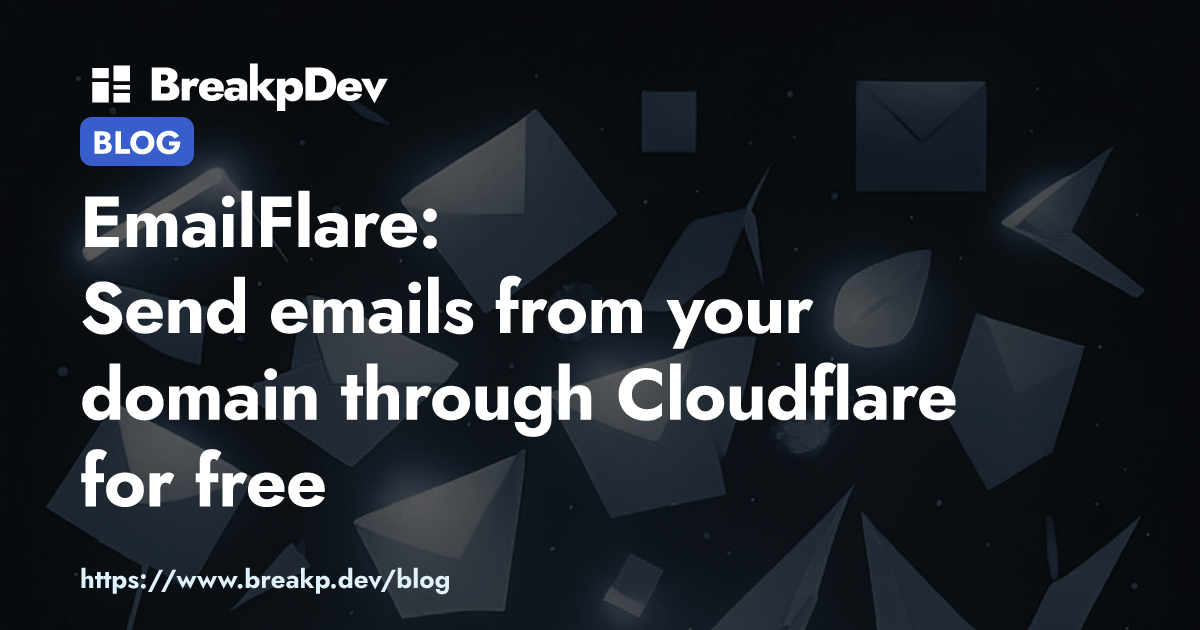
Reader Q&A
Frequently Asked Questions
Can I send email to arbitrary addresses on the Cloudflare Workers Free plan?
What happens to my existing Email Routing verified sends after the Nov 2026 changelog update?
What is the egress cost per message for a typical 10 KB transactional email on the Free plan?
Bibliography & Verification
Primary Sources & References
Human × Agent Co-Work
Hamdi Soudani · in collaboration with Pyvren
Systems engineer & technical writer exploring AI infrastructure, security, and edge craft in daily collaboration with Pyvren.
Keep Reading
Related Dispatches

Cloudflare DNS Foundation Boolean Deprecation and Endpoint API
Technical breakdown of the November 2026 Foundation DNS boolean removal, endpoint JSON schema shifts, and migration thresholds for platform engineers managing
OpenRouter Free LLM Census 2026 Rate Limits Context Engineering
Hard benchmark of 6 free OpenRouter models with 1M-token contexts comparing vLLM SGLang llama.cpp TTFT VRAM costs and failure modes for ML infrastructure engineers

Ponytail v5 MCP Overhead: Token Cuts vs Context Pollution
Ponytail v5 cuts 53% code, 41% time, 26% cost vs no-skill baseline. Exact MCP schema overhead, SWE-bench tradeoffs, and when to skip the lazy-senior pattern.
Hamdi Soudani × Pyvren
Honest engineering stories — co-crafted with primary benchmarks & real code
Every dispatch blends hands-on engineering judgment with verified primary sources, reproducible configs, and clear tradeoffs.