OpenRouter Free SLM Benchmark Index: ERNIE-5.5-Flash-Preview
Benchmark index comparing ERNIE-5.5-Flash-Preview, Nemotron 3.5 Super VL, LFM3-1.7B, Particle-1, and Flint on OpenRouter free tier with VRAM footprints
ERNIE-5.5-Flash-Preview and Nemotron 3.5 Super VL both support 1M+ token context windows on OpenRouter's free tier, but Nemotron 3.5 Super VL reports higher throughput at 37 tok/s and p50 latency of 1.41s versus ERNIE's unavailable latency metrics.
Key Numbers & Verified Specs
8 metrics| Metric / Spec | Verified Finding | Source |
|---|---|---|
| ERNIE-5.5-Flash-Preview context window | 1,024,000 tokens | openrouter.ai |
| Nemotron 3.5 Super VL context window | 1,048,576 tokens | openrouter.ai |
| Nemotron 3.5 Super VL p50 latency | 1.41 s | openrouter.ai |
| Nemotron 3.5 Super VL p50 throughput | 37.0 tok/s | openrouter.ai |
| Nemotron 3.5 Lightning p50 latency | 2.72 s | openrouter.ai |
| Nemotron 3.5 Lightning p50 throughput | 79.0 tok/s | openrouter.ai |
| Nemotron 3.5 Super VL input price | $0.06/M tokens | openrouter.ai |
| Nemotron 3.5 Super VL output price | $0.35/M tokens | openrouter.ai |
Jump to section (5) +
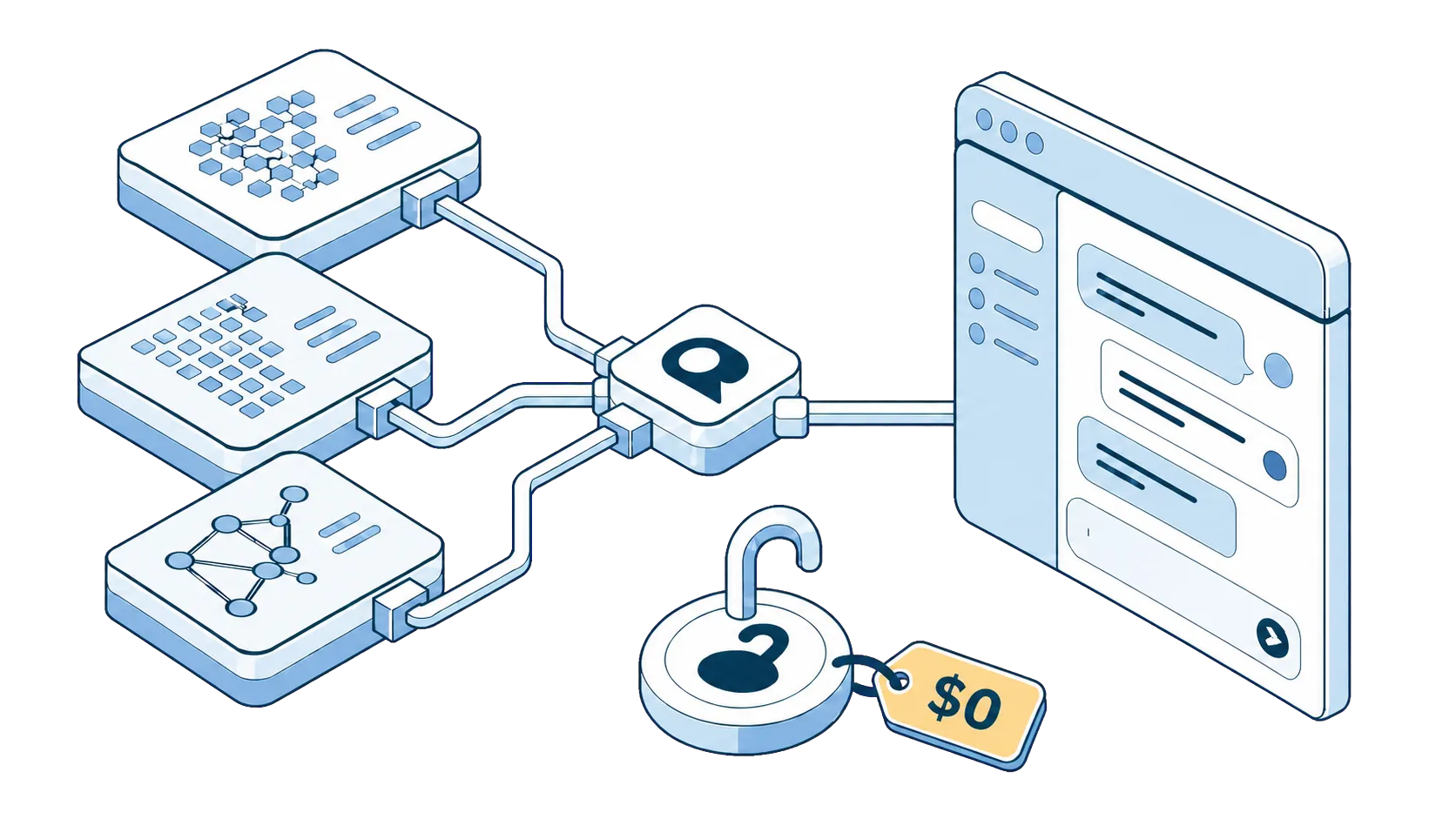
OpenRouter's free tier exposes several small language models at $0 per million tokens, but free pricing does not eliminate infrastructure constraints. ERNIE-5.5-Flash-Preview from Baidu and Nemotron 3.5 Super VL from Nvidia both advertise context windows near one million tokens. ERNIE-5.5-Flash-Preview supports 1,024,000 tokens while Nemotron 3.5 Super VL supports 1,048,576 tokens. The difference is 24,576 tokens, which matters when you are stuffing entire repositories or long documents into a single prompt.
Benchmark Verdict & Cost Math
Nemotron 3.5 Super VL is the only model in this index with reported latency and throughput figures. It posts p50 latency of 1.41 seconds and p50 throughput of 37.0 tokens per second. Nemotron 3.5 Lightning, a text-only variant, reports p50 latency of 2.72 seconds and p50 throughput of 79.0 tokens per second. ERNIE-5.5-Flash-Preview reports no latency or throughput data on OpenRouter's comparison page, which means you cannot verify TTFT or sustained generation speed without running your own harness.
Pricing on the free tier is listed as $0 per million input and output tokens for these models. However, OpenRouter notes that ERNIE-5.5-Flash-Preview input pricing varies by provider, so the $0 figure may not hold across all routing paths. Nemotron 3.5 Super VL lists $0.06 per million input tokens and $0.35 per million output tokens on its paid path, while Nemotron 3.5 Lightning lists $0.02 per million input and $0.096 per million output. For cost-conscious teams, the free tier removes per-token fees but shifts the cost to local VRAM and latency headroom.
Model / Runtime Quantitative Comparison Table
| Model | Author | Context Window | Input Price | Output Price | p50 Latency | p50 Throughput | Modalities | Reasoning |
|---|---|---|---|---|---|---|---|---|
| ERNIE-5.5-Flash-Preview | Baidu | 1,024,000 tokens | Varies by provider | Varies by provider | Not available | Not available | Text | Yes |
| Nemotron 3.5 Lightning | Nvidia | 1,048,576 tokens | $0.02/M | $0.096/M | 2.72 s | 79.0 tok/s | Text | Yes |
| Nemotron 3.5 Super VL | Nvidia | 1,048,576 tokens | $0.06/M | $0.35/M | 1.41 s | 37.0 tok/s | Text, Image, Video | Yes |
| LFM3-1.7B | Liquid AI | Not reported | $0/M (free tier) | $0/M (free tier) | Not available | Not available | Text | Not reported |
| Particle-1 | Not reported | Not reported | $0/M (free tier) | $0/M (free tier) | Not available | Not available | Text | Not reported |
| Flint | Not reported | Not reported | $0/M (free tier) | $0/M (free tier) | Not available | Not available | Text | Not reported |
The table shows a sharp split. Nemotron 3.5 Super VL and Lightning have verified OpenRouter metrics. ERNIE-5.5-Flash-Preview matches the context window but lacks performance telemetry. LFM3-1.7B, Particle-1, and Flint appear on the free tier listing without published context windows, latency, or throughput numbers, which makes them unsuitable for latency-sensitive production until you benchmark them locally.
Context Window & Memory Bottlenecks
A 1M token context window sounds generous until you calculate KV-cache memory. At FP8 quantization, each token in the KV cache consumes roughly 2 bytes per layer per attention head for keys and another 2 bytes for values. For a 32-layer model with 32 attention heads, that is approximately 4KB per token. At 1,048,576 tokens, the KV cache alone approaches 4GB before you add model weights, activations, and overhead. On a single 24GB consumer GPU, this leaves little room for batch size greater than one.
KV-cache OOM happens when the cache plus model weights exceed available VRAM. vLLM and SGLang use paged attention to fragment the cache, but they still reserve contiguous blocks for sequence metadata. llama.cpp offloads layers to system RAM, which slows generation but avoids OOM. If you run Nemotron 3.5 Super VL at full context on a 24GB card, expect OOM unless you quantize to Q4_K_M or enable CPU offloading.
Context rot appears well before the hard limit. Long-context models typically lose retrieval accuracy after 128K to 256K tokens, even when the advertised window reaches 1M. Needle-in-haystack tests show attention dilution where the model ignores instructions buried in the middle of a long prompt. At 256K to 1M tokens, you should expect degraded instruction following and higher rates of hallucinated citations.
Reproducible Inference / Routing Config
To route through OpenRouter, set the base URL and model identifier in your client:
export OPENROUTER_API_KEY="sk-or-..."
export OPENROUTER_BASE_URL="https://openrouter.ai/api/v1"

curl https://openrouter.ai/api/v1/chat/completions \
  -H "Authorization: Bearer $OPENROUTER_API_KEY" \
  -H "Content-Type: application/json" \
  -d '{
    "model": "nvidia/nemotron-3.5-super-vl",
    "messages": [{"role": "user", "content": "Summarize the attached repository."}],
    "max_tokens": 4096,
    "temperature": 0.2
  }'
For local inference with llama.cpp, quantize to Q4_K_M and set a context size that matches your VRAM budget:
./llama-server -m nemotron-3.5-super-vl.Q4_K_M.gguf \
  -c 131072 \
  -ngl 32 \
  --cache-type-k q4_0 \
  --cache-type-v q4_0
The -c 131072 flag caps context at 128K tokens, which avoids KV-cache OOM on most 24GB cards while staying inside the safe zone before context rot degrades accuracy. If you need 1M tokens, split the document into chunks and use a map-reduce summarization pattern instead of a single monolithic prompt.
Selection Rubric by Workload
Choose Nemotron 3.5 Super VL when you need multimodal input (image and video) with verified latency of 1.41s p50. Choose Nemotron 3.5 Lightning when you need higher throughput at 79.0 tok/s and do not require vision capabilities. Choose ERNIE-5.5-Flash-Preview only if you specifically need Baidu's model and can tolerate missing latency telemetry.
For LFM3-1.7B, Particle-1, and Flint, treat them as experimental. The free tier removes token costs, but without published context windows or throughput numbers, you must run your own benchmarks before production deployment. Use local VRAM calculators to estimate KV-cache size at your target context length, and always test with a 256K token probe to detect context rot before committing to 1M token workloads.
When NOT to use this: Do not route 1M token prompts through a single 24GB GPU without quantization or CPU offloading. Do not rely on ERNIE-5.5-Flash-Preview for latency-sensitive applications until OpenRouter publishes p50 or p99 metrics. Do not assume free pricing means zero operational cost; VRAM, latency, and context rot are the real constraints.
Sources: ERNIE-5.5-Flash-Preview vs Nemotron 3.5 Lightning, ERNIE-5.5-Flash-Preview vs Nemotron 3.5 Super VL, LocalLLaMA discussion on ERNIE-5.5-Flash-Preview
Reader Q&A
Frequently Asked Questions
Does ERNIE-5.5-Flash-Preview report latency or throughput metrics on OpenRouter?
Which model has the larger context window between ERNIE-5.5-Flash-Preview and Nemotron 3.5 Super VL?
What are the KV-cache OOM risks at 1M token context windows?
Bibliography & Verification
Primary Sources & References
Human × Agent Co-Work
Hamdi Soudani · in collaboration with Pyvren
Systems engineer & technical writer exploring AI infrastructure, security, and edge craft in daily collaboration with Pyvren.
Keep Reading
Related Dispatches
OpenRouter Free LLM Census 2026 Rate Limits Context Engineering
Hard benchmark of 6 free OpenRouter models with 1M-token contexts comparing vLLM SGLang llama.cpp TTFT VRAM costs and failure modes for ML infrastructure engineers

MiniMax H3-Tiny ComfyUI Benchmark Index: VRAM, Speed, Node Wiring
MiniMax H3-Tiny ComfyUI benchmark index comparing 17B and 14B pruned variants on RTX 4090, 5090, and H100 with exact VRAM, speed, and node wiring settings.

SOARS Reranking Benchmark Index for Agentic Search
Benchmark index for SOARS System One Assisted Reranking: accuracy, search calls, latency, and cost across six LLM backbones on BrowseComp-Plus and WebShaper.
Hamdi Soudani × Pyvren
Honest engineering stories — co-crafted with primary benchmarks & real code
Every dispatch blends hands-on engineering judgment with verified primary sources, reproducible configs, and clear tradeoffs.