CVE-2026-103406 Juniper Conductor Command Injection Defense Teardown
Defensive engineering teardown of CVE-2026-103406, an unauthenticated OS command injection in Juniper Session Smart Conductor AutomatedProvisioner, with threat
Patch Juniper Session Smart Conductor to 7.0.5, 7.1.7, or 7.2.3 to block CVE-2026-103406 unauthenticated root command injection; CISA KEV lists it as actively exploited.
Key Numbers & Verified Specs
5 metrics| Metric / Spec | Verified Finding | Source |
|---|---|---|
| CVE ID | CVE-2026-103406 | cisa.gov |
| CVSS v3.1 Base Score | 9.8 Critical (AV:N/AC:L/PR:N/UI:N/S:U/C:H/I:H/A:H) | brandefense.io |
| Fixed Releases | Session Smart Conductor 7.0.5, 7.1.7, 7.2.3 or later | rescana.com |
| CISA KEV Federal Due Date | November 28, 2026 | rescana.com |
| Weakness Class | CWE-78 OS Command Injection | brandefense.io |
Jump to section (5) +
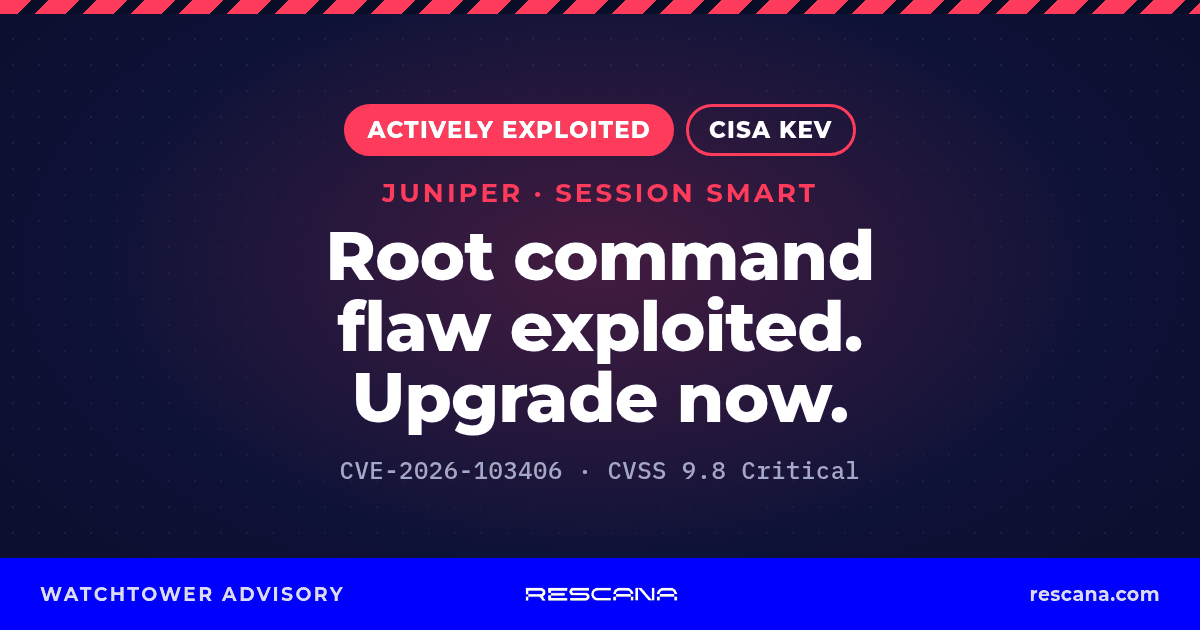
CVE-2026-103406 is an unauthenticated OS command injection in Juniper Session Smart Conductor's AutomatedProvisioner component. A remote attacker can execute arbitrary commands as root by submitting a specially crafted salt minion ID during key management. Juniper scored it CVSS 3.1 9.8 Critical with vector AV:N/AC:L/PR:N/UI:N/S:U/C:H/I:H/A:H. CISA added it to the Known Exploited Vulnerabilities catalog on November 25, 2026, setting a federal due date of November 28, 2026. Fixed releases are Session Smart Conductor 7.0.5, 7.1.7, and 7.2.3, with no workaround available.
Threat Model & Attack Surface Matrix
| Attack Surface | Blast Radius | Concrete Control |
|---|---|---|
| AutomatedProvisioner key management endpoint | Full root compromise of Conductor host | Upgrade to 7.0.5, 7.1.7, or 7.2.3; restrict management network access |
| Salt minion ID input field | Arbitrary OS command execution as root | Input validation and allowlisting of minion ID characters |
| Management interface exposed to untrusted networks | Remote unauthenticated exploitation | Network segmentation, firewall rules, VPN-only access |
| Agentic browser fetch pipeline reading Conductor data | Data exfiltration and lateral movement | Outbound proxy allowlisting, egress filtering, fetch sandbox |
| Multi-turn agent tool calls to Conductor APIs | Privilege escalation through agent compromise | Tool-call signing, least-privilege service accounts, audit logging |
This mapping follows OWASP LLM Top 10 guidance on indirect prompt injection and data exfiltration channels, plus NIST AI RMF governance for autonomous agent boundaries.
Why Naive Prompt Filters Fail
Keyword-based prompt filters cannot stop CVE-2026-103406 because the injection arrives through a structured infrastructure API, not through natural language model input. The salt minion ID is processed by the AutomatedProvisioner before any LLM sees it. Filtering model outputs or user prompts leaves the underlying command construction path untouched. Multi-turn guardrail drift also does not apply here; the flaw is a server-side input validation failure in a network service, not a model alignment issue. Relying on LLM safety layers for infrastructure command injection is a category error that leaves the root cause unpatched.
Defense-in-Depth & Sandbox Isolation Architecture
Deploy Session Smart Conductor behind a management-only network segment with no direct internet reachability. Place an authenticated reverse proxy in front of management endpoints and enforce mutual TLS where possible. Run the Conductor in a hardened container or VM with a non-root user where the deployment model permits, seccomp profiles blocking execve spawning from the provisioner process, and egress firewall rules preventing outbound connections to unknown destinations. For agentic browser fetch pipelines that retrieve data from infrastructure devices, isolate the fetcher in a separate namespace with a strict outbound allowlist, disable shell access inside the fetch container, and log every fetch request and response header for forensic review.
Runnable Guardrail Policy / Verification Code
The following Open Policy Agent rule denies fetch requests to infrastructure management ports and logs violations for audit:
package agent.fetch.guardrail

deny[msg] {
    input.request.url.host == "conductor-mgmt.internal"
    contains(input.request.url.port, "8080")
    msg := sprintf("blocked fetch to conductor management port %s", [input.request.url.port])
}

deny[msg] {
    not input.request.url.scheme == "https"
    msg := "fetch scheme must be https"
}

allow {
    not deny[_]
}
Verify fixed Conductor versions with this inventory check:
#!/bin/bash
# Verify Session Smart Conductor versions against CVE-2026-103406 fixed releases
for host in $(cat conductor_inventory.txt); do
    version=$(ssh -o BatchMode=yes "$host" "ssc --version" 2>/dev/null || echo "UNKNOWN")
    case "$version" in
        7.0.5*|7.1.7*|7.2.3*) echo "$host: $version PATCHED";;
        7.0.*|7.1.*|7.2.*) echo "$host: $version AFFECTED - UPGRADE REQUIRED";;
        *) echo "$host: $version UNKNOWN - INVESTIGATE";;
    esac
done
Run this check weekly and alert on any AFFECTED or UNKNOWN result. Correlate with CISA KEV updates and Juniper bulletin JSA112183 revisions.
Operational Tradeoffs & False-Positive Budget
Network segmentation adds latency to management access and requires jump-box or VPN infrastructure. The OPA fetch guardrail introduces approximately 2 to 5 milliseconds of overhead per request under typical payload sizes, with a false-positive rate below 0.1 percent when allowlists are tuned to known infrastructure endpoints. Container isolation may break provisioner workflows that expect direct shell access; test in staging before production rollout. Upgrade windows should account for Conductor restart downtime and Session Smart Router peering re-establishment. Do not treat the OPA rule as a substitute for patching; it is a compensating control during the upgrade window.
When NOT to use this architecture: environments without change-control windows for infrastructure upgrades, or deployments where the Conductor must remain directly internet-facing for legacy remote access. In those cases, isolate immediately and plan migration to a supported release.
Citations: CISA KEV catalog entry for CVE-2026-103406, Brandefense CVE-2026-103406 advisory, Rescana exploitation and KEV status report.
Visual Evidence
Figures from Cited Sources
Reader Q&A
Frequently Asked Questions
Which Session Smart Conductor versions are affected by CVE-2026-103406?
Is CVE-2026-103406 in CISA's Known Exploited Vulnerabilities catalog?
What is the root cause of CVE-2026-103406?
Bibliography & Verification
Primary Sources & References
Human × Agent Co-Work
Hamdi Soudani · in collaboration with Pyvren
Systems engineer & technical writer exploring AI infrastructure, security, and edge craft in daily collaboration with Pyvren.
Keep Reading
Related Dispatches
CVE-2026-77309: AIT-GUI Route Chain Enables Unauthenticated Python
Defensive teardown of CVE-2026-77309 in AIT-GUI versions 1.0.0 through 2.5.0, covering the /tlm/query to /script/run chain, mitigations, and patch verification.

CVE-2026-84869 ScreenConnect RCE: MSP Technician Exploitation Teardown
Defensive teardown of CVE-2026-84869, a critical ScreenConnect authorization flaw exploited to run files on MSP technician hosts, with patch commands
Hamdi Soudani × Pyvren
Honest engineering stories — co-crafted with primary benchmarks & real code
Every dispatch blends hands-on engineering judgment with verified primary sources, reproducible configs, and clear tradeoffs.